Trauma.
We were girls once.

I like to understand people. Sometimes, I do and then I realise, I don't.
But, I will try. I always try.
In this quest, I was able to understand that sometimes, although unjustifiable, bad experiences make bad people.
We are a people, turned and twisted by our experiences, no matter how little, it shapes us. It influences everything, our choices and decisions, how we live our lives, even to the smallest detail sometimes.
I will tell you about Temi, a 16 year old that stopped eating egg roll and coke after a near rape incident with a prospect that defended himself by stating that he had earlier gifted her egg roll and a coca cola drink. I cannot even explain to you how that incident affected her mental health but she is well. I'm thankful, she's learning to see the world in a better way than what was thrusted to her face. I'm thankful for her strength and her courage.
We were girls once, without troubles, bubbly and happy, carefree till our experiences shaped us and refined us.
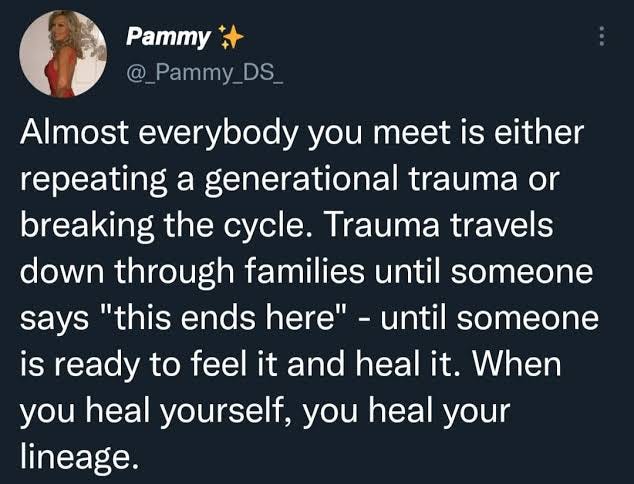
Getting hurt as children leaves a mark, and we grow up, sometimes, unaware of our scars. Unconsciously, we repeat the cycle and even when we are aware of the pain, in order to break the cycle, we overcompensate and hurt people in the same way we were hurt.
I'll define trauma…
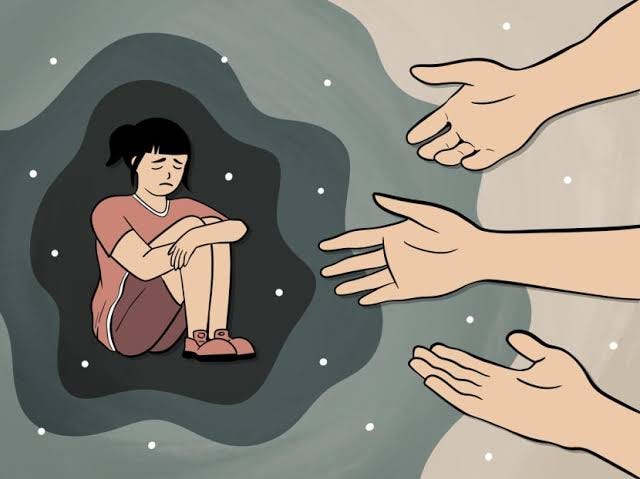
Trauma is an emotional response to a distressing event; an abuse — emotional, sexual, financial, neglect, harassment, bullying etc.
The thing about an emotional response is that it is person dependent.
“ Tolu and Tayo, brothers from a middle class family grew up in Ikorodu, Lagos. Seeing their parents struggle and the financial abuse from relatives, both brothers decided that they were going to be rich. But while Tolu earned his money legitimately, Tayo was into fraudulent activities.”
“Two girls after a rape incident. Girl A becomes reclusive and reclines from men and is even repulsed by men. Girl B goes into prostitution”.
I think it is unfair that this is not justifiable. Pain can build fear in people and can build strength in others. People respond to trauma differently.
We talk too much about derailment and much less about the cause. But how do we break this curse without addressing the root. The crime officers are doing their job taking criminals and keeping them out of society, but why is no one addressing the makings of a criminal.
I'm not one to justify crimes or wrong acts, but this is just me wondering aloud if there would be no bad people, if there were no bad experience.
Trauma could be anything, as long as you are responding to it. It can be due to lack of emotional support, neglect, and financial hardship.
If you'd ask ‘how’, I'll tell you about those who were raised by absent parents, I will also tell you about those who experienced hand on physical and sexual abuse.
Trauma interferes with how we view the world. Words that have been thrown at us, we expect again and again. We also replay in our head, on our way back from school, in the shower. We never forget, it just sticks and seeps into our identity. Even when we are in a better place, with better people and better conditions, we are constantly living in fear, waiting for the other shoe to drop.
You will agree that trauma begins from home, in the ways we were raised and in the ways our parents were raised. Then, you will see clearly how all of this has just been a repeated cycle. An unhealthy one.
People make culture, culture does not make people.
The culture of silence: “3 generation of women were raped and each kept the secret, smothering the scars in silence.”
We do more damage when we avoid sensitive topics and foster secrecy and denial.
Silence is not golden when people are faced with abuse, bias, discrimination, prejudice and bias.
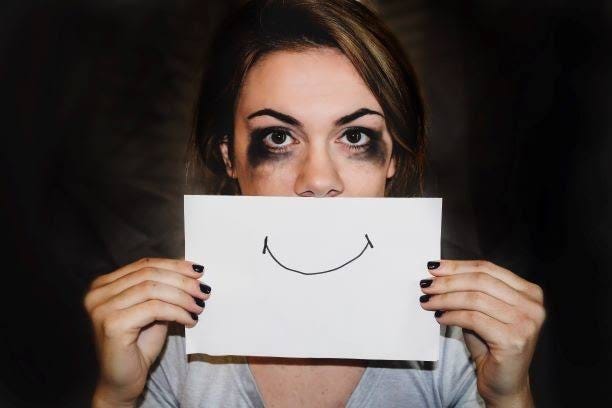
The culture of shame, stigma and discrimination: We blame the victims, label survivors as “weak”, we say to them, “you should have been stronger”. We make people who have mental illness feel ashamed, we stigmatise them with our perception, in our language, our behaviour and attitude and we deprive them of access. We make them see mental health as personal failure.
The culture of ignorance: When society associates trauma with weakness, and spreads misinformations and we encourage people with the wrong opinion on trauma and mental health.
These unhealthy cultures are very evident in our society.
What ways were we raised by our parents that we need to start changing?
If you were raised and you needed therapy to feel better, you need to be conscious enough to not raise kids that would need therapy. Children will model after their caregivers.
If you don't heal, you're likely to project your hurts and pain onto your offspring.
You need to focus on reparenting yourself, and be the change agent. The one that breaks the cycle of trauma.
Usually, fear is the enemy. Fear would make us run from our past and we would work tirelessly to prevent a recurrence, but because of fear, we don't care enough as to how we achieve our goal. Time has proven that fear induced actions are destructive.
If the goal is to create a healthy change, fear cannot be the driving force. It has to be purposeful, the desire to leave a legacy and change the story of pain.
As with many other things, change must start from yourself. “I am no good to anyone, if I am no good to myself”.
Challenge yourselves to show up better as individuals, in your family, your family will be able to show up stronger in the community and the community will be able to build a resiliency of an entire culture starting with our younger people.
Love,
Victoria. 🤍